 Take our user survey and make your voice heard.
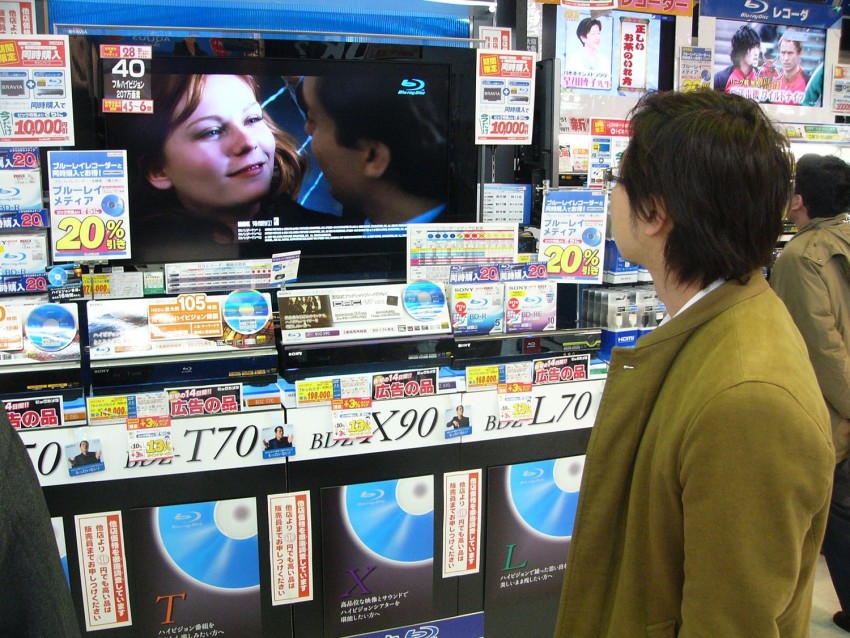
There are some people out there who bought a laser disc player many years ago because it had the best picture quality. Then they switched to Betamax videotapes but they were surpassed by VHS. More recently, those same people might have bought a Toshiba HD DVD next generation player. A salesman at BIC Camera at Yurakucho recalled one elderly man asking in frustration: “Can’t they make up their minds?”
Well, they finally have. Toshiba’s announcement last month that it was dropping its HD DVD format, ceding market leadership to the Blu-ray format backed by Sony Corp and Matsushita Electric Industrial Co, has saved millions of consumers the frustration of deciding which one to buy. “Now people are coming in asking to see Blu-ray recorders and wanting to know more about what it actually is,” said the salesman.
Blu-ray gets its name from the underlying laser used to read and write data. The DVD player uses a blue-violet color laser. According to the Blu-ray Disc Association (a group of companies representing consumer electronics, computer hardware and motion picture production), manufacturers deliberately left the “e” out in order to trademark the name.
By 2004, Sony, Matsushita and other companies were pushing ahead with that format, while Toshiba, NEC, Samsung, Philips and others opted for a cheaper high-density optical disc that became known as HD DVD. The battle became reminiscent of the fierce war between the Betamax and VHS formats of the 1980s.
Marketing finally determined the winner. “We carefully assessed the long-term impact of continuing the so-called ‘next-generation format war’ and concluded that a swift decision will best help the market develop,” Atsutoshi Nishida, president and CEO of Toshiba, said at a Tokyo news conference. “While we are disappointed for the company and more importantly, for the consumer, the real mass market opportunity for high definition content remains untapped and Toshiba is both able and determined to use our talent, technology and intellectual property to make digital convergence a reality.” Sony pressured studios
While the announcement was made in Japan, the decision was made in the U.S. by movie studios who backed Blu-ray. It’s clear that Sony heavily pressured movie studios to release their movies on Blu-ray DVDs, but rumors have swirled on some U.S. media websites that Sony offered Toshiba an incentive to drop HD DVD in the form of a sweet microchip deal (the two companies have set up a joint venture to produce high-performance semiconductors, including products for Sony’s PlayStation video game consoles).
“There’s no doubt Sony lobbied movie studios,” Phillip Swann, president and CEO of TVPredictions.com, said in an email interview. “Both sides did, which is how Toshiba initially peeled away Paramount and DreamWorks last year and how Sony got Warner in January.” Sony’s driving force was its CEO, Howard Stringer, who told Fortune magazine in a recent interview that he wanted “to exorcise the ghosts of the failed Betamax video tape format that has haunted the halls at Sony for two decades.”
In early January, Toshiba made a last-ditch effort to expand its market share in the U.S. by drastically cutting prices of its DVD players. But Warner’s announcement that it will exclusively release DVDs in the Blu-ray format from June was the final clincher. “That had tremendous impact,” Toshiba’s Nishida said of the Warner decision. “If we had continued, that would have created problems for consumers, and we simply had no chance to win.”
Even prior to the Warner bombshell, U.S. retailer Wal-Mart Stores Inc had announced that its outlets will only stock high-definition DVDs and players in the Blu-ray format. Universal Studios, which had been a Toshiba backer, jumped on the bandwagon, too. “While Universal values the close partnership we have shared with Toshiba, it is time to turn our focus to releasing new and catalog titles on Blu-ray,” Craig Kornblau, president of Universal Studios Home Entertainment and Universal Pictures Digital Platforms, said in a statement to media.
Blu-ray swept 90% of sales of next-generation DVD recorders in Japan in the last three months of 2007, although HD DVD fared somewhat better in the US market where it was supported by software giant Microsoft Corp. In Japan, Microsoft has seen the writing on the wall and will end production of external HD DVD players for its Xbox 360 game console. However, Microsoft said it will continue its customer support operations for those who have purchased the add-on player. The fact that the PlayStation 3 console included a Blu-ray drive is yet another reason the format eventually won out. Sony has sold 10.5 million PS3 machines since its 2006 debut.
Both HD DVD and Blu-ray discs deliver crisp, clear pictures and sound, making them a perfect match for the high-definition TV sets on the market, but it was never a question of which technology was superior, but rather who was best at marketing, Swann said. “HD DVD had a few more interactive features while Blu-ray has more storage. Sony and Blu-ray won because they secured the support of four major studios. HD DVD had only one studio exclusively supporting it.” Reminiscent of VHS-Betamax war
The decision is frustrating, especially for those who went through the same thing with the Betamax-VHS war. For a while, it seemed that Sony and Toshiba had learned from that debacle and in 2005, both camps held several high-level meetings to try and decide on a single format. “There was pressure from the industry to create a single format before the two formats were launched. But egos and financial pressures blocked a compromise,” said Swann.
Toshiba will continue providing consumers who bought HD DVD products with after-sales services. In Japan, Toshiba said it has sold 30,000 HD DVD decks, accounting for only 5% of its HD DVD sales throughout the world. Major Japanese consumer electronics retailer Edion Corp, in a generous move, is allowing customers to return HD DVD products to swap for rival Blu-ray machines through March 31. Subject to the trade-in are seven Toshiba-made recorder and player models, including the RD-A1, RD-A300, HD-XA1 and HD-XA2, sold at some 1,100 Deodeo Corp, Eiden Co and other retail outlets. Customers with receipts can exchange their HD DVD products for machines made by Sony, Matsushita or other manufacturers in the Blu-ray camp.
At least, the fallout won’t be as bad as the Betamax-VHS war, which forced Betamax owners to buy new recorders and videotapes. Few people have been willing to buy a high-definition DVD player with the chance it could become obsolete if the other standard won out, so many consumers are still using first-generation DVD players. While you will need a Blu-ray player to play Blu-ray discs, the standard DVDs sold now will still play on a Blu-ray player (and HD DVD player, if you want to keep it), so you won’t be stuck with useless DVD collections. However, as new movies start to get released only in the Blu-ray format, you will have to buy a Blu-ray player eventually.
No need to rush out and buy Blu-ray player
Analysts say there is no need to rush out and buy a Blu-ray player. ABI Research, a U.S. company that monitors the technology market, predicts that it will take 12 to 18 months for Blu-ray players to become as cheap and full-featured as HD DVD players both in the U.S. and Japan. Sony’s challenge is to get consumers to buy its Blu-ray players and its ads in Japan are already encouraging consumers who are thinking of buying its LCD Bravia TVs to also get a Blu-ray player at the same time. Sony is scheduled to release more than 100 Blu-ray titles this year, a 54% increase over last year.
Blu-ray will have to catch up with its defeated rival on interactive features. HD DVD players were able to connect to the Internet to download trailers and other bonus content for discs. Blu-ray players capable of showing picture-in-picture – a feature called “Bonus View” – have only just started to appear.
Sony recently announced two models for the U.S. with new online interactivity. “With a special feature known as BD-Live, users will be able to connect their players to the Internet and access related content in addition to the special features pre-recorded on the disc,” said a Sony spokesperson in Tokyo. “Although these features will not be incorporated in Japanese models until next year or later, they indicate the interactive potential of this technology.”
Both models feature an external port for local storage, so users can add optional flash-based memory. The players are compatible with most standard DVDs and feature 1080p upscaling through an HDMI connection to capable HDTV sets, improving the picture performance of existing DVD libraries, Sony says.
Challenge from online providers
In any case, Blu-ray’s victory may be short-lived because it faces even greater competition from online service providers. A growing number of consumers now download music and videos online and don’t bother to store them on DVDs. Production of music CDs is on the decline as more and more people download music, and a similar phenomenon may happen in the DVD market.
“After years of standards war, the major question for Sony and the Blu-ray camp is whether a physical format for high-definition still has any relevance to consumers in this era of Internet-delivered movies and video on demand (VOD),” said David Carnevale, vice president of multimedia content and services at market researchers Gartner and iSuppli, in a report.
Online movie download services from iTunes, Amazon and others have gained traction in recent years and increased their movie, TV, and other video content offerings. “The Internet gives consumers a choice of building a library of HD movies bought over the Internet instead of buying a Blu-ray Disc player and building a new library of movies on discs,” said Carnevale.
Leading the charge is Apple TV, which Apple Inc has just launched in the U.S. With this new online service, a special device attached to a TV set allows viewers to instantly rent movies from every major Hollywood studio without using a computer. A total of 1,000 titles including 100 high-definition ones are available, Apple said, adding that its research shows that more than half of young Americans now watch TV programs via the Internet. Apple has yet to decide whether to offer the same service in Japan. Even though next-generation DVDs offer cinematic-quality images and multimedia features, DVD sales are not growing in Japan where few residences have enough space to accommodate collections. In the all-important U.S. market, DVD sales fell 3.2% last year to $15.9 billion, according to Adams Media Research, the first annual drop in the medium’s history. Adams projects another decline in 2008 and 2009.
A few years ago, sales got a boost when studios started offering boxed sets of TV series. But 10 seasons of anyone’s favorite TV show take up a lot of shelf space and how often are you going to watch them anyway? Studios will have to fight tooth and nail against online competition. They earn big bucks through theatrical release first, then through home video and finally to video-on-demand, pay-per-view and regular free TV channels.
Swann of TVPredictions.com thinks the digital download industry will challenge Blu-ray, but he sees Blu-ray being dominant for the next few years. “It will take years — yes, years — before downloads will be ready to take over the living room. They are too complicated, too costly and the picture is sub-par. I disagree that downloads are becoming more practical — that's just propaganda from the tech world.”
He says the average consumer does not have the patience or technical skill to use a download service at home, such as Apple TV, Vudu or even XBox 360’s service. Plus, download times are usually too long (sometimes hours for a high-def movie) and the picture quality is sub-par to what you see on a Blu-ray or HD DVD disc. So it looks like the sidelines are the best place for consumers to stay for a while.
Now if we only we could figure out whether to buy a plasma or LCD TV. Stay tuned for the next battle.
© Japan Today













2 Comments
Login to comment
smartacus
I am one of those people who always picks the wrong format. I had a laser disc and a Betamax. recently, I bought a plasma TV and it looks like that's going to lose out to LCD.
kimigano
With Japan's internet TV content providers like Gyao trying to recruit nobodies like Magibon from YouTube, it's hard to see any hope in what they're doing. Sony's looking better and better every day.